Key Takeaways
- What it is: An Amino acid in green tea.
- Main Benefit: Relaxation without drowsiness.
- Typical Dose: 100–200 mg.
- Safety: Generally recognized as safe
What Is L-theanine?
L-theanine (Camellia sinensis), a unique amino acid found almost exclusively in tea plants. As a dietary supplement, it is a popular natural approach to relieve stress and promote calm, but with increased mental energy.1
In green tea leaves, L-theanine comprises between 1 to 4% of the dry weight. It has also been available as a dietary supplement since 1994, when it was approved in Japan for use as an aid to conquer stress and promote relaxation. That popularity has spread to North America, and now L-theanine can be found as the critical ingredient in functional foods and beverages and dietary supplements designed to produce mental and physical relaxation without inducing drowsiness.
Clinical studies confirm that L-theanine effectively reduces stress and anxiety without making you drowsy. Instead, it promotes a state of 'calm focus.' It also works quickly—most people feel the effects within 30 minutes, and the benefits can last for 8 to 12 hours.
Supports Brain Health
L-theanine exerts many exciting effects, primarily on brain chemistry. The easiest way to look at theanine is as an "anti-caffeine" molecule, but that is somewhat limiting. Caffeine is a stimulant, and theanine buffers some of the effects of caffeine in the brain. It is incorrect to think of theanine as a "sedative." L-theanine is anything but that as it stimulates brain energy, just much different from caffeine.1-3
In animal models, L-theanine has been shown to increase brain levels of many different brain chemicals, especially neurotransmitters that carry signals from one brain cell to another. It improves brain function, learning, and memory in these studies. That is probably why forms of green tea rich in theanine, like matcha, were so valued as an aid to meditation and revered in green tea ceremonies.
One of the critical outcomes of theanine's complex actions in the brain is to increase the production of α-brain waves.4 These brain waves are associated with feelings of calmness and focus. During meditation, α-brain waves are abundant. It is interesting to note that matcha, the form of green tea most valued by ancient Japanese monks for their tea ceremony, is the richest source of theanine with only a modest caffeine content. Theanine accentuates the meditative state by promoting greater mental focus and alertness. In addition to boosting α-brain waves, theanine also lowers β-waves. This brain wave pattern is associated with nervousness, scattered thoughts, and hyperactivity.
Reduces Stress + Anxiety
L-theanine can facilitate positive changes in brain chemistry, promote alpha brain waves, and reduce beta waves, resulting in reduced feelings of stress, anxiety, irritability, and anxiousness caused by caffeine.1-3 That said, when L-theanine is used with caffeine, it has been shown to enhance cognitive skills and improve attention span, the ability to process visual information, and increase accuracy when switching from one task to another. All positive effects.4-6
A 2024 randomized controlled trial followed healthy adults experiencing moderate stress for 28 days. Participants taking 400 mg of L-theanine daily reported significantly lower perceived stress levels and less "light sleep" (indicating deeper rest) compared to the placebo group.14
Improves Sleep Quality
Research also indicates that L-theanine can enhance the quality of sleep.1,2 It is not a sedative (sleep-promoting agent) per se, but it does promote sleep by promoting a more relaxed state of mind.
A systematic review published in 2025 analyzed 13 randomized controlled trials involving over 500 participants. It concluded that L-theanine, at doses between 200–450 mg/day, significantly improved sleep latency (the time it takes to fall asleep) and overall sleep efficiency without causing daytime drowsiness.12
Enhances Focus + Mental Performance
L-theanine on its own may help improve brain function and thus mental performance.1,2 A 2024 double-blind, placebo-controlled study focused on sleep-deprived young adults. It found that a single dose of 200 mg of L-theanine significantly improved selective attention and reduced reaction times during simulated driving tasks compared to a placebo. This suggests L-theanine can help maintain focus and reduce errors even when a person is fatigued.13
Several other studies showed that the combination of L-theanine and caffeine (e.g., 97 mg and 40 mg, respectively) could significantly improve specific mental tasks and alertness in adults.4-6
In a 2021 double-blind study with a single 100 mg dosage of L-theanine and a daily dosage of 100 mg for 12 weeks, significantly improved brain function. The subjects were men and women between the ages of 50 and 69 years old.9 A battery of tests known as Cognitrax was used to assess cognitive function. Evaluations were performed before the intervention, after a single dose of L-theanine, and after 12 weeks of regular intake. Results showed L-theanine reduced the reaction time to the attention task, and it increased the number of correct answers, and decreased the number of omission errors in working memory tasks. These results are due to L-theanine redistributing attention resources to improve mental focus efficiently. The researchers concluded that L-theanine might contribute to enhancing attention, thus enhancing working memory and executive functions.
Earlier studies showed that L-theanine, as a sole agent, improves certain mental functions with chronic use. Still, it is hard to separate this effect from direct versus indirect by reducing the adverse impact on cognitive performance caused by stress or poor sleep. For example, in one study, L-theanine (200 mg/day) or placebo tablets were given to subjects for four weeks.10 Assessments included those for depression, anxiety, and sleep quality, along with a battery of mental tests. Results showed significant improvements in sleep and mood, and improved cognitive functions, verbal fluency, and executive function scores. The findings indicated that the improvements in cognitive function were closely tied to the advancements in sleep and mood.
ADHD Support
L-theanine's ability to promote feelings of calmness implies that it might be helpful in attention deficit hyperactivity disorder (ADHD). In conjunction with the University of British Columbia, the Canadian Center for Functional Medicine conducted a double-blind, placebo-controlled study in boys ages 8-12 diagnosed with ADHD to take 200 mg of L-theanine twice daily as a chewable tablet.7 The primary outcome from the study showed that L-theanine worked safely and effectively to improve the quality of their sleep, helping them sleep more soundly, which is a huge benefit to children with ADHD. Disturbed sleep is a significant factor in childhood ADHD.
L-theanine may have additional benefits in ADHD. In a study published in 2020, a very detailed analysis was conducted looking at a single dosage of L-theanine (2.5 mg per kg body weight), caffeine (2 mg per kg body weight), and their combination vs. placebo on brain function in boys (8-15 years old) with ADHD. The study also included functional magnetic resonance imaging (fMRI) to gauge their effects on brain networking. The complex results indicated that the L-Theanine-caffeine combination might be a potential therapeutic option for ADHD-associated impairments in sustained attention, inhibitory control, and overall cognitive performance.8
The researchers suggested the morning administration of this combination of L-theanine and caffeine "may prove to be more useful in other aspects of ADHD, such as poor attention and hyperactivity." 8
How L-theanine Works
L-theanine is absorbed and delivered to the brain across the blood-brain barrier, promoting relaxation with greater mental focus and clarity. It enables this desired state by increasing the brain's levels of crucial neurotransmitters like dopamine, serotonin, and gamma-aminobutyric acid (GABA) while at the same time antagonizing the effect of the excitatory neurotransmitter glutamate.1,2
L-theanine also exerts anti-inflammatory effects on brain cells and can protect brain cells against stress and age-related damage.
One of the critical net effects noted with L-theanine ingestion is that it enhances alpha brain waves associated with a state of "wakeful relaxation" while simultaneously reducing the beta brain waves associated with nervousness, scattered thoughts, and hyperactivity. The brain wave pattern promoted by L-theanine is related to the state of mind during meditation, relaxed mental focus, and creativity. Again, this effect explains the use of match in the tea ceremony of Japan by monks to enhance their meditation.4
There is another effect of L-theanine that aids in fighting stress, reducing cortisol levels. This effect is essential as elevated cortisol and related stress hormones can interfere with memory and learning.3
What L-Theanine Does In The Body
- Increases brain serotonin, dopamine, and GABA levels
- Counteracts some of the stimulatory effects of caffeine
- Produces mental and physical relaxation without inducing drowsiness
- Improves learning and memory in both human and animal studies
- Produces positive results in double-blind studies showing it:
- Reduces feelings of stress
- Enhances the quality of sleep
- Diminishes the symptoms of the premenstrual syndrome
- Increases the production of alpha brain waves
- Reduces the production of beta brain waves
L-Theanine In Green Tea
Any discussion on the health benefits of green tea would be incomplete without highlighting L-theanine. The tea plant utilizes L-theanine to synthesize its polyphenols, specifically catechins, during the process of photosynthesis. Theanine is also the compound responsible for the characteristic taste and aroma of green tea. As for green tea sources, matcha has a high amount of theanine as its cultivation involves shading the tea plant for the last three weeks before harvesting. The result is that less photosynthesis occurs, so more theanine is left on the leaves, giving matcha its characteristic sweetness and flavor. Shading also causes the tips of the plant to concentrate chlorophyll, resulting in a brighter green color for matcha. While traditional green tea may have theanine content as low as 5 mg per cup, shade-grown green tea, such as matcha, may contain as much as nine times this amount per cup, or approximately 45 mg. However, most matcha contains 25 to 30 mg per cup. As for caffeine content, matcha comes in at a modest 30 mg per cup. So, there is generally an equal amount of L-theanine and caffeine in matcha.
L-Theanine Dosage
Based on the results of numerous clinical studies, it has been established that L-theanine is effective in the range of 100 to 200 mg per day. Although L-theanine is without any known adverse drug interaction, it is recommended to take no more than 600 mg within 6 hours and no more than 1,200 mg within 24 hours.
At doses of around 100 to 200 mg, L-theanine does not act as a sedative but significantly improves sleep quality. It is also an excellent synergist between melatonin and 5-HTP (5-hydroxytryptophan) in promoting sleep.
Side Effects + Safety
L-theanine is safe and without side effects based on numerous safety studies and clinical trials.1,2 Beyond that, L-theanine has been consumed in beverages, foods, and supplements since 1994 with no indication of adverse reactions or contraindications. The L-theanine, known as Suntheanine, received confirmation from the United States Food and Drug Administration in 2007 as a Generally Recognized as Safe (GRAS) ingredient for its use in food and beverages, and is available as a dietary supplement.
Drug Interactions
There are no known drug interactions with L-theanine. L-theanine may help the action of anti-anxiety and antipsychotic medications. For example, a 2011 study published in the Journal of Clinical Psychiatry clearly showed the benefit of L-theanine in improving the effectiveness of psychiatric drugs. In the study, 60 patients with schizophrenia added 400 mg per day of L-theanine to their ongoing antipsychotic treatment for over 2.5 years.11 Compared with placebo, L-theanine augmentation was associated with a significant reduction of anxiety and mental symptoms. L-theanine was found to be safe, and there were no adverse drug reactions.
References:
- Williams JL, Everett JM, D'Cunha NM, et al. The Effects of Green Tea Amino Acid L-Theanine Consumption on the Ability to Manage Stress and Anxiety Levels: a Systematic Review. Plant Foods Hum Nutr. 2020;75(1):12-23.
- Türközü D, Şanlier N. L-theanine, unique amino acid of tea, and its metabolism, health effects, and safety. Crit Rev Food Sci Nutr. 2017;57(8):1681-1687.
- Kimura K, Ozeki M, Juneja L.R., Ohira H. L-Theanine reduces psychological and physiological stress responses. Biol Psychol. 2007;74(1):39-45.
- Kobayashi k, Nagato Y, Aoi N, et al. Effects of l-theanine on the release of α-brain waves in human volunteers. Nippon Nogeikagaku Kaishi 1998;72:153–157.
- Dodd FL, Kennedy DO, Riby LM, Haskell-Ramsay CF. A double-blind, placebo-controlled study evaluating the effects of caffeine and L-theanine both alone and in combination on cerebral blood flow, cognition and mood. Psychopharmacology (Berl). 2015;232(14):2563-2576.
- Giesbrecht T, Rycroft JA, Rowson MJ, De Bruin EA. The combination of L-theanine and caffeine improves cognitive performance and increases subjective alertness. Nutr Neurosci. 2010;13(6):283-290.
- Lyon MR, Kapoor MP, Juneja L.R. The effects of L-theanine (Suntheanine®) on objective sleep quality in boys with attention deficit hyperactivity disorder (ADHD): a randomized, double-blind, placebo-controlled clinical trial. Altern Med Rev. 2011;16(4):348-354.
- Kahathuduwa CN, Wakefield S, West B.D., et al. Effects of L-theanine-caffeine combination on sustained attention and inhibitory control among children with ADHD: a proof-of-concept neuroimaging RCT. Sci Rep. 2020;10(1):13072.
- Baba Y, Inagaki S, Nakagawa S, et al. Effects of l-Theanine on Cognitive Function in Middle-Aged and Older Subjects: A Randomized Placebo-Controlled Study. J Med Food. 2021;24(4):333-341.
- Hidese S, Ogawa S, Ota M, et al. Effects of L-Theanine Administration on Stress-Related Symptoms and Cognitive Functions in Healthy Adults: A Randomized Controlled Trial. Nutrients. 2019;11(10):2362.
- Ritsner MS, Miodownik C, Ratner Y, et al. L-theanine relieves positive, activation, and anxiety symptoms in patients with schizophrenia and schizoaffective disorder: an 8-week, randomized, double-blind, placebo-controlled, 2-center study. J Clin Psychiatry. 2011;72(1):34-42.
Cotter J, Caddick CE, Harper JL, Ebajemito JK. Examining the effect of L-theanine on sleep: a systematic review of dietary supplementation trials. Nutr Neurosci. 2025 Nov 1:1-15. doi: 10.1080/1028415X.2025.2556925. Epub ahead of print. PMID: 41176609.
Karunaratne UW, Dassanayake TL. Effect of L-theanine on selective attention in a traffic-related reaction task in sleep-deprived young adults: a double-blind placebo-controlled, crossover study. Nutr Neurosci. 2025 Apr;28(4):471-480. doi: 10.1080/1028415X.2024.2383080. Epub 2024 Jul 25. PMID: 39052627.
Moulin M, Crowley DC, Xiong L, Guthrie N, Lewis ED. Safety and Efficacy of AlphaWave® L-Theanine Supplementation for 28 Days in Healthy Adults with Moderate Stress: A Randomized, Double-Blind, Placebo-Controlled Trial. Neurol Ther. 2024 Aug;13(4):1135-1153. doi: 10.1007/s40120-024-00624-7. Epub 2024 May 17. PMID: 38758503; PMCID: PMC11263523.
DISCLAIMER:
These statements have not been approved by the Food and Drug Administration. These products are not intended to diagnose, treat, cure, or prevent disease.


























































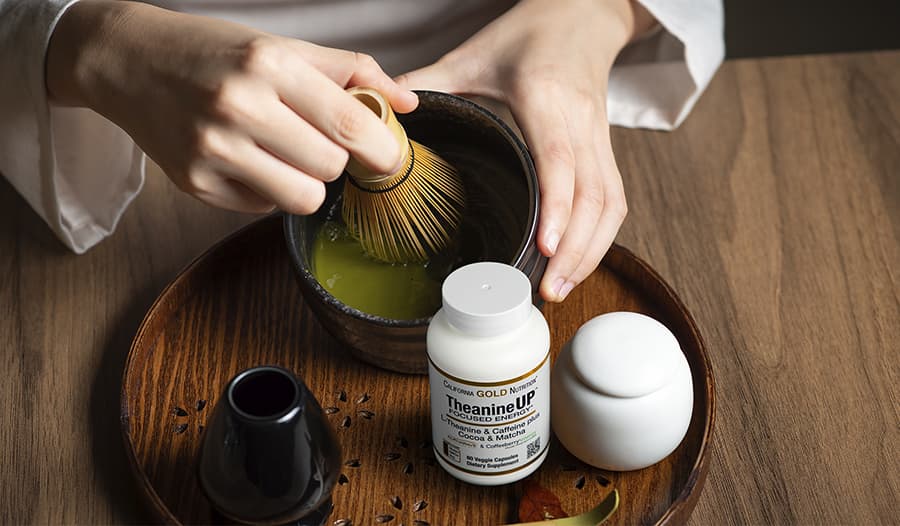
 Table of Contents